Painting a World a Child Can Step Into An Illustrator’s Note on Imagination, Patience, and the Small Details That Make Stories Come Alive By Leanna Friedman
When I illustrate a children’s book, I am never simply drawing a picture to sit beside a few lines of text. I am helping build a world. For a young child, that world can become very real. A tree is…
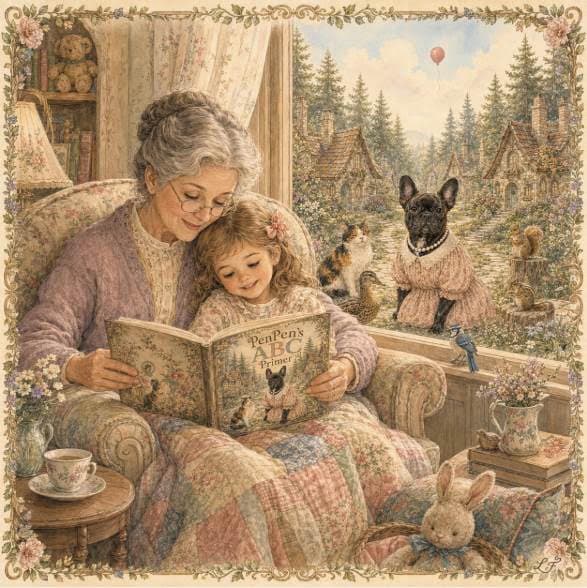
When I illustrate a children’s book, I am never simply drawing a picture to sit beside a few lines of text. I am helping build a world.
For a young child, that world can become very real.
A tree is not just a tree. It may be where a shy character hides, where two friends meet, or where a tiny bird waits unnoticed until the child discovers it on the fourth or fifth reading. A red scarf, a crooked window, a bright yellow flower, or the expression in a character’s eyes can become part of how a child remembers the story.
That is what makes illustrating for children such a joy—and such a responsibility.
The Picture Has to Carry Part of the Story
Young children often experience a book in two ways at once. They listen to the words, but they also study the pictures.
Sometimes the pictures tell them things the words do not.
A character may look uncertain even though the text says nothing about being afraid. A mother may be watching quietly from the background. A little animal may be getting into trouble on the other side of the page. A familiar object may appear again and again, giving the child something to recognize and anticipate.
Those details create depth.
They help children understand emotion, relationships, humor, place, and personality. They also encourage children to look closely, ask questions, make connections, and imagine what might happen beyond the edge of the page.
That is why every illustration has to respect the story.
The art should never feel like decoration pasted onto the words. It should belong to the same world.
Good Illustrations Usually Begin With a Lot of Bad Ones
There is a funny truth about illustration: the finished picture may look effortless, but getting there rarely is.
A character may be drawn over and over before the expression feels right.
The eyes may be too serious.
The smile may be too large.
The room may feel too empty.
The colors may be fighting with each other.
A pose that seemed charming in a sketch may look completely wrong when the whole page comes together.
So I change it.
Then I change it again.
Illustrating a book is a long conversation between imagination and revision.
You try something. You look at it. You ask whether it serves the story. You move a character three inches. You change the color of a dress. You soften a background. You redraw a hand, an ear, a hat, a paw, a flower, or sometimes an entire scene.
There can be dozens of decisions hiding inside one seemingly simple illustration.
Children may never know about those decisions.
That is perfectly fine.
They are not supposed to see the work.
They are supposed to feel the magic.
Characters Need to Feel Like Friends
One of the things I care about most is consistency in the characters.
If a child spends an entire book with a character, that character should begin to feel familiar.
Children should recognize the way the character stands, smiles, dresses, moves, reacts, and relates to others. A character needs a visual personality just as much as a written one.
That takes commitment.
If a character is gentle, the illustrations should help us feel that gentleness.
If another is mischievous, perhaps we can see the beginning of trouble in the eyes before the story tells us what happened.
If someone is wise, shy, brave, silly, proud, kind, worried, or curious, I want the child to sense some of that before anyone explains it.
Those visual clues matter because children are learning how to read more than words.
They are learning how to read faces.
They are learning how to recognize feelings.
They are learning that people and characters can communicate through posture, expression, color, movement, and small gestures.
Art gives us another language for all of that.
Color Is Part of the Experience
Children are naturally drawn to color, but I do not think color should simply be loud for the sake of being loud.
Color can create a feeling.
Soft blues can make a scene peaceful.
Warm yellows can make a room feel welcoming.
Greens can make a village or forest feel alive.
A sudden splash of red can guide the eye toward something important.
Even quieter colors can give a child a place to rest before the next exciting moment.
Choosing a palette is one of my favorite parts of the process because it helps establish the emotional rhythm of the book.
Children begin forming associations with colors very early. They notice contrasts, patterns, shapes, repetition, and relationships. A thoughtfully illustrated book can invite them to explore all of those things without ever feeling like a lesson.
That is the beauty of it.
Learning can arrive disguised as wonder.
There Should Always Be Something More to Discover
Some of my favorite children’s books are the ones that reveal something new every time they are opened.
That is something I think about constantly.
Can I add a small object in the background that becomes meaningful later?
Can an animal appear in several scenes?
Can a character’s expression quietly change as the story progresses?
Can a child discover something the grown-up reading the book did not notice?
These details make repeat reading more rewarding.
And children love repetition.
They may ask for the same book night after night, and that gives the illustrator a wonderful opportunity. A picture should not give up everything it has the first time it is seen.
There should be room for discovery.
A tiny surprise.
A visual joke.
A familiar shape.
A favorite character waiting in the corner.
Something that makes a child point and say, “Look!”
That little word may be one of the greatest compliments an illustrator can receive.
Imagination Deserves Our Best Effort
Adults sometimes forget how enormous a child’s imagination can be.
A cardboard box can become a castle.
A blanket can become a mountain.
A stuffed animal can have an entire personality, history, family, and set of opinions.
Children do not require expensive machinery to enter another world.
They simply need an invitation.
A picture can provide that invitation.
That is why I believe the effort behind children’s illustration should feel almost boundless.
We sketch.
We redraw.
We adjust.
We experiment with color.
We study expressions.
We reconsider backgrounds.
We think about the story from the child’s point of view.
We ask whether the page feels exciting enough, gentle enough, funny enough, clear enough, or warm enough.
We keep working because somewhere there may eventually be a child sitting on a parent’s lap, lying under a blanket, visiting a library, or turning a page alone for the first time.
That child deserves our attention.
Art Can Help a Child Grow
A beautifully illustrated story can entertain, but it can also quietly encourage development.
Pictures invite children to observe.
Characters invite empathy.
Colors encourage curiosity.
Patterns encourage recognition.
Stories encourage memory.
Expressions help children identify feelings.
Scenes encourage questions.
And imagination helps children begin making connections between the world inside the book and the world around them.
None of this requires a children’s book to become a textbook.
Quite the opposite.
The most meaningful learning often happens when the child is simply absorbed in the experience.
They are enjoying the story.
They are laughing.
They are wondering.
They are noticing.
They are imagining.
And while all of that is happening, they are growing.
The Goal Is Wonder
When I work on an illustration, I want to give children more than something pretty to look at.
I want to give them somewhere to go.
I want them to feel that the characters have lives beyond the page. I want the village, house, forest, garden, classroom, kitchen, or imaginary kingdom to feel like a place they could almost visit.
I want them to care about what happens next.
Most of all, I want the art to make their imaginations a little bigger.
That requires patience, iteration, discipline, affection for the characters, respect for the story, and a willingness to keep working until the picture feels right.
Sometimes that means changing one tiny detail.
Sometimes it means starting over.
But creating art for children is worth that effort because childhood is filled with first encounters: first stories, first favorite characters, first colors that feel magical, first books memorized by heart.
An illustrator gets to become a small part of those memories.
I cannot think of many privileges greater than that.
— Leanna Friedman, Illustrator of a new series coming this fall to Ideovee Children’s Books.
Leanna Friedman is the illustrator of PenPen’s Adventures, bringing Whispering Pines Grove and its lovable characters to life with warmth, charm, and rich storybook detail. Her illustrations are created to spark curiosity, imagination, and a sense of wonder in young children while giving parents and caregivers beautiful images to explore together. Leanna is drawn to children’s books because art can help a child understand a story, recognize emotions, and discover that reading can be joyful. Her goal is to create illustrations that children remember fondly long after the final page is turned.